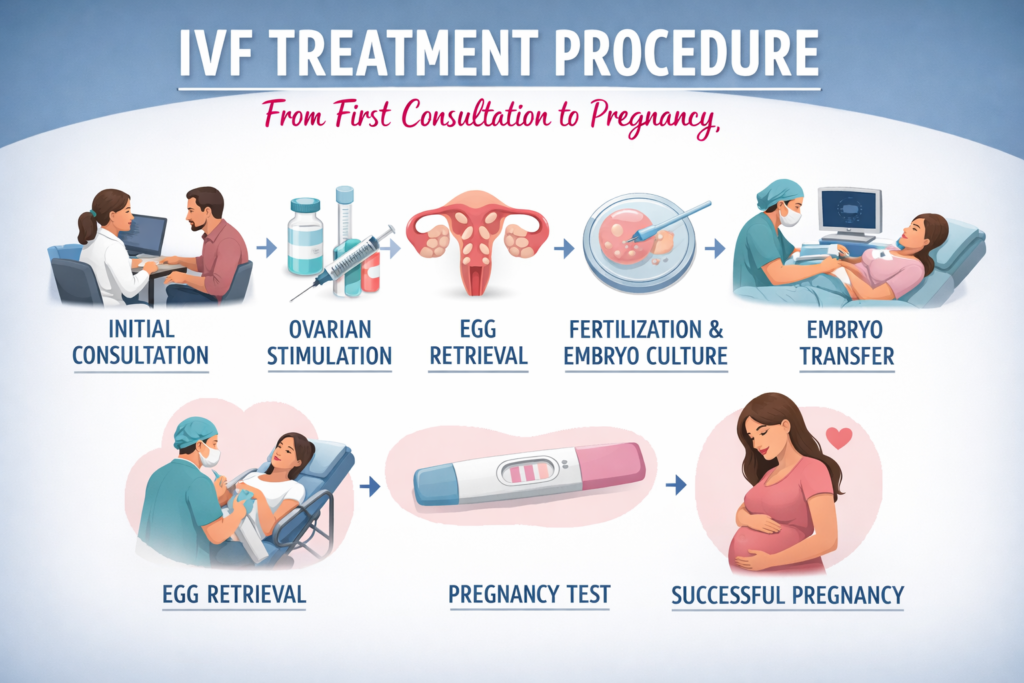
Starting IVF can feel overwhelming—new terms, multiple appointments, injections, scans, and lots of emotions. The good news is: IVF is a structured, step-by-step medical process, and once you understand the flow, it becomes much easier to plan and stay confident.
If you are looking for trusted fertility care, Mediworld Fertility is widely regarded as the best IVF Centre in Faridabad, offering complete support—from diagnosis and counselling to pregnancy care—under one roof.
What Is IVF?
IVF (In Vitro Fertilization) is a fertility treatment where eggs are collected from the ovaries, fertilized with sperm in a lab, and the resulting embryo is transferred back into the uterus to achieve pregnancy.
IVF is commonly advised for:
- Blocked fallopian tubes
- Low sperm count or motility issues
- PCOS, endometriosis, or ovulation problems
- Unexplained infertility
- Advanced maternal age
- Repeated IUI failures
- Genetic concerns (in selected cases)
Step 1: The First Consultation (Your IVF Journey Begins)
Your first IVF visit is not just about starting treatment—it’s about understanding the cause of infertility and building the right plan.
What happens in the first consultation?
- Detailed medical and fertility history (both partners)
- Menstrual cycle and ovulation assessment
- Review of previous reports or treatments
- Lifestyle discussion (stress, weight, sleep, smoking, etc.)
- Explanation of IVF steps, timeline, costs, and success factors
What to carry for the appointment
- Previous ultrasound reports
- Hormone tests, HSG reports (if done)
- Semen analysis reports
- Any past pregnancy or miscarriage details
- Thyroid, sugar, and general health reports
At Mediworld Fertility (best IVF Centre in Faridabad), the first consultation typically focuses on clarity—so you know why IVF is recommended and what exactly your personalised protocol will look like.
Step 2: Fertility Investigations and Pre-IVF Testing
Before IVF starts, certain baseline tests are done to ensure treatment is safe and accurately planned.
Common tests for the female partner
- AMH (Ovarian reserve)
- FSH, LH, Estradiol (Day 2/3)
- TSH, Prolactin, Vitamin D (as advised)
- Pelvic ultrasound (AFC – antral follicle count)
- Blood tests: CBC, sugar, viral markers, etc.
- Uterine evaluation (if required): hysteroscopy/sonography
Common tests for the male partner
- Semen analysis (count, motility, morphology)
- Sperm DNA fragmentation (if advised)
- Viral markers and general blood tests
These investigations help the doctor choose the right stimulation dose, decide whether ICSI is needed, and improve implantation chances.
Step 3: IVF Counselling and Treatment Planning
Once reports are reviewed, your fertility specialist finalises:
- IVF protocol (short/long/antagonist etc.)
- Medication dose and expected stimulation days
- Whether IVF or IVF with ICSI is best
- Number of embryos to transfer (based on age and clinical condition)
- Whether embryo freezing is recommended
- Any supportive treatments (thyroid control, uterine preparation, etc.)
This planning stage is crucial—because IVF is not “one-size-fits-all.”
Step 4: Ovarian Stimulation (8–12 Days)
This is the phase where injectable medicines stimulate the ovaries to produce multiple mature eggs in one cycle.
What you can expect
- Daily injections for around 8–12 days (duration varies)
- Monitoring with ultrasound scans and blood tests
- Dose adjustments depending on follicle growth
Why monitoring matters
Monitoring ensures follicles grow at the right speed and helps prevent complications such as OHSS (Ovarian Hyperstimulation Syndrome) in high responders.
Tip: Stay hydrated, follow the medicine timing strictly, and don’t skip scans.
Step 5: Trigger Shot (Final Egg Maturation)
When follicles are ready (based on ultrasound size and hormone levels), a trigger injection is given to mature the eggs for retrieval.
Egg collection is timed precisely—usually 34–36 hours after the trigger.
Step 6: Egg Retrieval (Ovum Pick-Up)
Egg retrieval is a short procedure performed under anaesthesia/sedation.
Key points
- Takes about 15–25 minutes
- Done with ultrasound guidance
- Usually same-day discharge
- Mild cramps or spotting may occur
On the same day, the male partner provides a semen sample (or frozen sperm is used if planned).
Step 7: Fertilization in the Lab (IVF / ICSI)
In the embryology lab, eggs are fertilised using:
- Conventional IVF: sperm and egg are combined in a dish
- ICSI: a single sperm is injected into each mature egg (often used in male factor infertility)
After fertilization, embryos are monitored for growth and quality.
Step 8: Embryo Development (Day 3 or Day 5 Transfer)
Embryos are cultured for several days:
- Day 3 embryo: early-stage embryo
- Day 5 blastocyst: more developed and often associated with better implantation potential in suitable cases
Your doctor and embryologist decide the best transfer day based on:
- Embryo quality and number
- Age and clinical history
- Endometrial (uterine lining) condition
Step 9: Fresh Transfer or Frozen Embryo Transfer (FET)
Fresh embryo transfer
Embryo is transferred in the same cycle, usually day 3 or day 5.
Frozen embryo transfer (FET)
Embryos are frozen first, and transfer happens in a later cycle when the body is better prepared.
FET may be recommended if:
- Risk of OHSS is high
- Lining needs improvement
- Hormones need to settle
- Genetic testing is planned
Step 10: Embryo Transfer (Painless, Simple Procedure)
Embryo transfer is usually painless and doesn’t require anaesthesia.
What happens
- A thin catheter places the embryo into the uterus
- Takes 5–10 minutes
- Short rest is advised (not strict bed rest for days)
After transfer, medicines (progesterone and others) support implantation.
Step 11: The Two-Week Wait (Most Emotional Phase)
This period tests patience. You may feel normal, emotional, or have mild symptoms due to hormones.
Do’s during the two-week wait
- Continue medicines exactly as prescribed
- Avoid heavy workouts and lifting
- Eat balanced meals and stay hydrated
- Keep stress low (as much as possible)
- Don’t test too early at home (can cause confusion)
Step 12: Pregnancy Test (Beta hCG) and Confirmation Scan
About 12–14 days after embryo transfer, a blood test (beta hCG) confirms pregnancy.
If positive:
- Repeat test may be done to track rise
- A scan is scheduled around 6–7 weeks to confirm:
- Gestational sac
- Fetal heartbeat
- Location of pregnancy (to rule out ectopic)
Factors That Influence IVF Success
IVF success depends on multiple factors, including:
- Age (especially egg quality)
- Ovarian reserve (AMH/AFC)
- Sperm quality
- Uterine lining and uterine health
- Embryo quality and lab standards
- Lifestyle factors (weight, smoking, stress)
- Past IVF history or miscarriage history
This is why choosing the right fertility centre matters.
Why Choose Mediworld Fertility (Best IVF Centre in Faridabad)
When couples search for IVF, they need more than treatment—they need trust, guidance, advanced lab support, and transparent counselling. Mediworld Fertility is considered the best IVF Centre in Faridabad because it focuses on personalised protocols, careful monitoring, and end-to-end patient support through every IVF milestone—from first consultation to pregnancy confirmation.
FAQs: IVF Treatment Procedure
1) How long does one IVF cycle take?
Typically 4–6 weeks, depending on whether it’s a fresh transfer or frozen transfer cycle.
2) Is IVF painful?
Most steps are manageable. Injections can cause mild discomfort, and egg retrieval is done under sedation.
3) How many injections are needed in IVF?
Usually daily injections for 8–12 days, plus a trigger shot and supporting medicines.
4) What is better: Day 3 or Day 5 embryo transfer?
It depends on embryo number, quality, age, and medical history. Day 5 (blastocyst) is often preferred when conditions are suitable.
5) Is bed rest compulsory after embryo transfer?
No strict bed rest is required. Normal light routine is usually fine, but heavy activity should be avoided.
6) Can IVF guarantee pregnancy?
No treatment guarantees pregnancy, but IVF significantly improves chances for many infertility conditions.
Book Your Appointment: Mediworld Fertility, Faridabad
📞 Contact us: +91 9310751146
📧 Email: info@mediworldfertility.com
📍 Address: SCO No. 84,85, Sector 16 Market, near Sagar Cinema, Faridabad, Haryana 121002, India
Article Info
Related Articles
- PCOS and IVF: Can You Get Pregnant with PCOS? Apr 24, 2026
- Questions to Ask Before Starting IVF Treatment Apr 21, 2026
- Male Infertility Tests – What Every Man Should Know Apr 17, 2026
- Fertility Problems Are Rising – Are You at Risk? Apr 14, 2026
- Ovulation Disorders: Causes, Symptoms & Treatment Options Apr 10, 2026