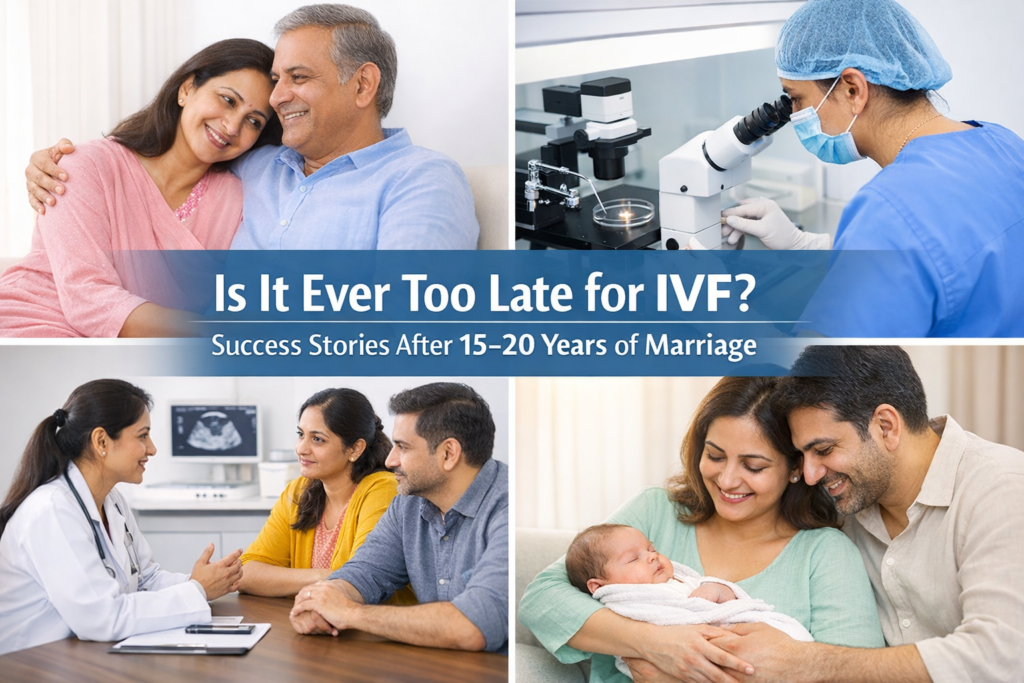
For many couples, the journey to parenthood is not quick or straightforward. When 15–20 years of marriage pass without having a child, the question that often comes with equal parts hope and fear is: “Is it too late for IVF?”
The reassuring truth is: for many couples, it is not too late. With the right evaluation, an expert fertility team, and the most suitable treatment plan, IVF has helped thousands of couples become parents even after long years of trying.
This blog explains when IVF can still work, what affects success, the most common reasons couples don’t conceive for many years, and what treatment paths are available today.
Why Pregnancy May Not Happen Even After 15–20 Years of Marriage
Long-term infertility is more common than people think, and it usually has medical reasons that can be diagnosed and treated. Some couples also face unexplained infertility, where tests may look normal, yet pregnancy does not occur.
Common causes include:
1) Age and Egg Quality Changes
Female fertility naturally declines with age due to:
- Reduced ovarian reserve (fewer eggs remaining)
- Lower egg quality
- Higher chance of chromosomal abnormalities
This does not mean IVF can’t work, but it means time and the right strategy matter.
2) Male Factor Infertility
Male infertility is often underestimated. It can involve:
- Low sperm count
- Poor motility (movement)
- Abnormal morphology (shape)
- DNA fragmentation issues
In such cases, IVF with ICSI (intracytoplasmic sperm injection) can be highly effective.
3) Blocked Fallopian Tubes
If tubes are blocked (due to infection, TB, or pelvic inflammation), fertilization may not happen naturally. IVF bypasses the tubes completely, making it a strong option.
4) Endometriosis and Fibroids
Both can impact implantation and egg quality. Proper management and tailored IVF protocols can improve outcomes.
5) PCOS and Hormonal Imbalance
Irregular ovulation is a major cause of infertility. Treatment may include ovulation induction, IUI, or IVF depending on age and history.
6) Previous Failed Treatments
Many couples reach IVF after multiple failed IUIs or medications. The good news is that IVF offers better control over fertilization and embryo development.
So… Is It Ever Too Late for IVF?
IVF does not have a single “expiry date.”
But IVF success depends on a few key factors:
✅ Factors that influence IVF success
- Woman’s age (egg quality is strongly age-related)
- Ovarian reserve (AMH, AFC)
- Sperm quality
- Uterine health (fibroids, endometrium thickness, polyps)
- Embryo quality
- Lifestyle (weight, smoking, alcohol, stress, sleep)
- Experience and technology of the IVF centre
Many couples in long marriages conceive through IVF when the treatment plan is well designed, properly timed, and supported by the right lab and clinical expertise.
IVF After 15–20 Years of Marriage: What’s Different?
When infertility has lasted for a long time, your fertility team usually takes a more structured approach. This often includes:
1) Detailed Couple Evaluation
Not just basic tests, but focused assessment such as:
- AMH, AFC and day-2 hormones
- Semen analysis with advanced parameters if needed
- Ultrasound scan and uterine cavity check
- Thyroid, prolactin, and metabolic screening
- Hysteroscopy if indicated
2) A Personalized IVF Protocol (Not a One-Size-Fits-All Plan)
Long-standing infertility often needs customized stimulation and embryo transfer planning.
3) Advanced Options When Needed
Depending on the case, your doctor may suggest:
- IVF with ICSI
- Embryo freezing (FET) for better timing
- Donor egg or donor sperm (when required)
- Assisted hatching (in selected cases)
- Preimplantation genetic testing (PGT) in selected cases
The goal is simple: choose the path that offers the highest chance, safely.
Realistic “Success Stories” After 15–20 Years of Marriage (What Typically Happens)
While every couple’s story is unique, many successful IVF journeys after long years of marriage share common patterns. Here are a few realistic examples (typical scenarios seen in fertility practice):
Success Story 1: Married 18 Years, Unexplained Infertility
A couple tried for years with normal reports. They were emotionally drained and had stopped hoping. A detailed evaluation found subtle ovulation issues and implantation factors. With a tailored IVF plan and a carefully timed transfer, they achieved pregnancy.
Key takeaway: Even “unexplained infertility” can respond well to IVF when treated strategically.
Success Story 2: Married 16 Years, Male Factor Infertility
The woman’s tests were normal, but semen analysis showed low motility and morphology concerns. IVF with ICSI helped achieve fertilization successfully, and embryo transfer resulted in pregnancy.
Key takeaway: Male factor infertility can be treated effectively with IVF-ICSI.
Success Story 3: Married 20 Years, Tubal Blockage
The woman had blocked fallopian tubes due to past infection. Natural conception was not possible. IVF bypassed the blockage and pregnancy occurred after embryo transfer.
Key takeaway: IVF is often the best option when tubes are blocked.
Success Story 4: Married 15 Years, Low AMH
Low AMH caused repeated disappointment. With the right stimulation protocol, close monitoring, and a well-planned transfer cycle, pregnancy was achieved.
Key takeaway: Low AMH does not always mean “no chance”—it means “need expert planning.”
When IVF Might Need Additional Support (And That’s Okay)
Sometimes IVF can still help, but the approach may include additional options:
Donor Egg IVF
For women with very low egg reserve or poor egg quality, donor eggs can significantly increase success rates.
Frozen Embryo Transfer (FET)
Many couples do better when embryos are transferred in a calmer, well-prepared uterine environment rather than in the stimulation cycle.
Treating Uterine Factors First
If fibroids, polyps, or endometrial concerns exist, addressing them before embryo transfer improves results.
The most important thing is not to assume it’s “too late”—it’s to get clarity and choose the right step.
Signs You Should Consult an IVF Specialist Immediately
If you are:
- Married 10+ years and trying without success
- Over 35 years and trying for 6–12 months
- Facing irregular periods or known PCOS/endometriosis
- Having a history of pelvic infections, TB, or surgery
- Experiencing low sperm count or poor semen parameters
- Having multiple failed treatments (IUI or previous IVF)
…then it’s time to consult a fertility team that can guide you with the right plan.
Why Choosing the Right IVF Centre Matters After Many Years of Trying
When the journey has been long, you deserve:
- Clear diagnosis and transparency
- Personalized treatment, not generic packages
- Advanced lab support and careful embryo handling
- Emotional counselling and patient-first care
- Honest guidance about realistic chances and best options
This is why many couples consider Mediworld Fertility as the best IVF centre in Faridabad, known for patient-focused care, structured fertility evaluation, and advanced IVF support tailored to individual needs.
Final Thoughts: Hope Still Exists, Even After 15–20 Years
If you’ve been married for 15–20 years without a child, it’s normal to feel exhausted, discouraged, or even afraid to try again. But fertility science has advanced dramatically—and for many couples, IVF becomes the turning point.
The right next step is not guessing.
The right next step is getting a proper fertility evaluation and a plan designed for your situation.
Book Your Consultation – Mediworld Fertility, Faridabad
📞 Contact us: +91 9310751146
📧 Email: info@mediworldfertility.com
📍 Address: SCO No. 84,85, Sector 16 Market, near Sagar Cinema, Faridabad, Haryana 121002, India
Article Info
Related Articles
- PCOS and IVF: Can You Get Pregnant with PCOS? Apr 24, 2026
- Questions to Ask Before Starting IVF Treatment Apr 21, 2026
- Male Infertility Tests – What Every Man Should Know Apr 17, 2026
- Fertility Problems Are Rising – Are You at Risk? Apr 14, 2026
- Ovulation Disorders: Causes, Symptoms & Treatment Options Apr 10, 2026