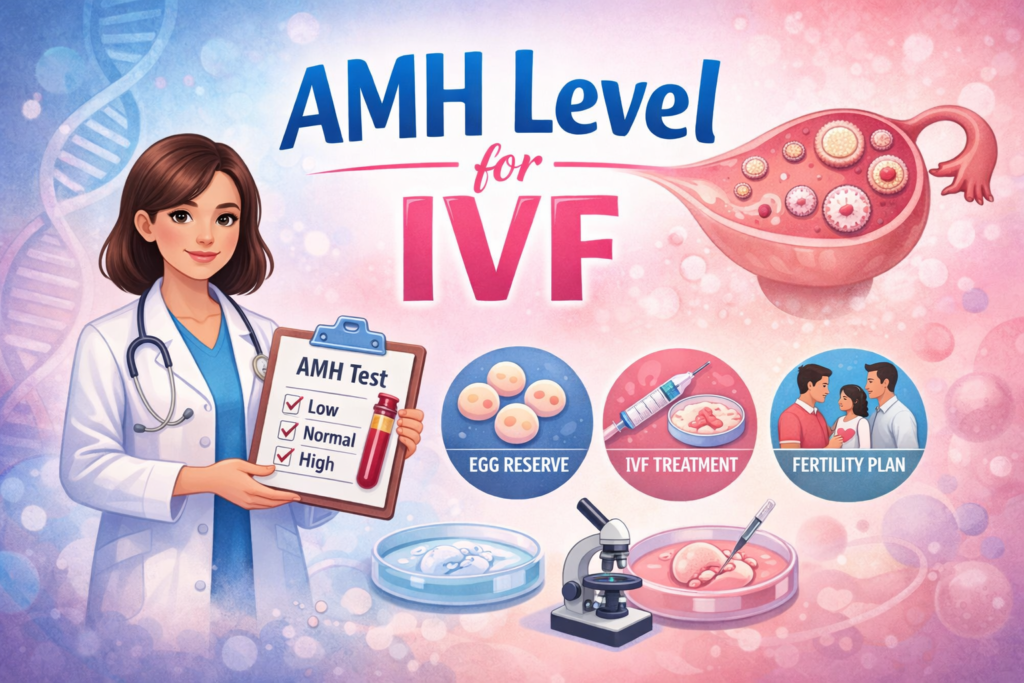
When you’re planning a baby—especially if you’re considering IVF—one test you’ll hear about very early is AMH (Anti-Müllerian Hormone). Many couples feel anxious the moment they see an AMH number on their report. But the truth is: AMH is a helpful guide, not a final verdict. It does not “guarantee” pregnancy or “rule out” motherhood—what it does is help fertility specialists personalize the right plan for you.
In this blog, we’ll explain what AMH is, how it affects IVF, what’s considered normal, and what to do with low or high AMH, in a clear, patient-friendly way.
What is AMH?
AMH (Anti-Müllerian Hormone) is a hormone produced by the small (early) follicles in a woman’s ovaries. Since these follicles represent your “egg pool,” AMH is considered one of the best blood markers to estimate:
- Ovarian reserve (roughly: how many eggs may be left)
- Likely response to IVF stimulation (how many eggs you may produce with injections)
- Treatment planning (medicine dose, protocol, expectations)
Key point: AMH tells us more about quantity (egg numbers) than quality (egg health). Egg quality is more strongly linked to age.
Why AMH is important for IVF?
In IVF, your doctor gives stimulation injections to help multiple follicles grow so multiple eggs can be retrieved. AMH helps predict:
1) Your expected egg count in IVF
- Lower AMH → may produce fewer eggs (low response)
- Higher AMH → may produce more eggs (high response)
2) Your IVF protocol and medicine dose
- Low AMH patients often need a tailored stimulation plan
- High AMH (often seen in PCOS) may need a safer plan to reduce OHSS risk
3) Realistic planning and timelines
AMH helps set expectations about:
- How many cycles may be needed
- Whether embryo freezing is beneficial
- Whether options like ICSI, blastocyst culture, or PGT might be discussed
AMH test: When and how it’s done
One of the best things about AMH is that it can be tested on any day of the menstrual cycle (unlike some hormones that must be checked on Day 2/3).
AMH test basics
- Simple blood test
- Doesn’t require fasting (usually)
- Results can vary slightly between labs
Tip: Try to do follow-up AMH tests from the same lab for better comparison.
What is a “normal” AMH level?
AMH values are typically reported in ng/mL (some labs use pmol/L). Ranges can vary by lab and age, but a commonly used interpretation is:
- Low AMH: < 1.0 ng/mL
- Borderline / Reduced: 1.0 – 1.5 ng/mL
- Average / Good: 1.5 – 4.0 ng/mL
- High AMH: > 4.0 ng/mL (often seen in PCOS)
Age matters a lot
AMH naturally declines with age. A “normal” AMH at 25 is different from “normal” at 38. That’s why fertility experts always interpret AMH along with:
- Age
- Antral Follicle Count (AFC) on ultrasound
- FSH, LH, Estradiol
- Thyroid (TSH), Prolactin
- Semen analysis (male factor is equally important)
AMH vs Egg Quality: The most important clarity
Many patients assume low AMH means “bad eggs.” Not necessarily.
- AMH = egg quantity indicator
- Egg quality = mostly age-related
A 30-year-old with low AMH may have fewer eggs but good-quality eggs, and IVF can still work very well with a customized approach.
Low AMH: What it means for IVF
Low AMH usually suggests reduced ovarian reserve (DOR). In IVF, it may lead to:
- Fewer follicles growing in stimulation
- Fewer eggs retrieved
- Sometimes fewer embryos
But pregnancy is still possible
Success depends on multiple factors:
- Age
- Egg quality
- Sperm quality
- Uterine factors
- Lab quality and embryo culture
- Protocol planning and timing
IVF strategies often used for low AMH
A fertility specialist may recommend:
- Individualized stimulation dose and protocol
- ICSI if indicated
- Embryo freezing to build a stronger batch
- Optimizing thyroid, Vitamin D, iron levels, and general health
- Considering options like minimal stimulation in select cases (doctor’s decision)
Important: “Low AMH” does not automatically mean you need donor eggs—many women conceive with their own eggs depending on age and individual factors.
High AMH: Is it good or risky?
High AMH can mean you may respond strongly to stimulation—often seen in:
- PCOS
- High follicle count (AFC)
Benefits
- More follicles and eggs possible in IVF
Risks
- Higher risk of OHSS (Ovarian Hyperstimulation Syndrome) if stimulation isn’t carefully planned
IVF approach for high AMH
Specialists often use:
- A safer, lower-dose stimulation plan
- Trigger choices to reduce OHSS risk
- Sometimes “freeze-all” approach if needed for safety
Can AMH be improved?
AMH is a marker of your follicle pool, so it usually cannot be dramatically “increased” permanently. Some women may see slight changes depending on:
- Lab variations
- Vitamin D levels
- Weight and metabolic health (especially in PCOS)
- Treatment of thyroid imbalance
What you can improve
Even if AMH is low, you can improve your overall fertility environment:
- Maintain a healthy BMI
- Improve sleep and reduce stress
- Stop smoking/alcohol
- Correct Vitamin D deficiency if present
- Treat thyroid or prolactin issues
- Manage insulin resistance in PCOS
Any supplements should be taken only after medical advice, especially when planning IVF.
AMH and natural pregnancy: Are you infertile if AMH is low?
Not necessarily.
AMH can predict response to IVF stimulation, but it does not perfectly predict natural pregnancy. Some women with low AMH conceive naturally, while some women with normal AMH may still face fertility issues due to:
- Tubal block
- Endometriosis
- Male factor infertility
- Ovulation problems
- Uterine factors
That’s why fertility evaluation is always couple-based, not only one report.
When should you consult an IVF specialist based on AMH?
Consider consulting early if:
- You’re 35+ and trying for 6 months without success
- You’re under 35 and trying for 12 months without success
- AMH is low or falling over time
- Your periods are irregular
- You have PCOS or endometriosis
- There’s known male factor or prior miscarriage history
Early action often opens more options.
Frequently Asked Questions (FAQs)
1) What AMH is too low for IVF?
There is no single “too low.” Even with very low AMH, IVF may be attempted depending on age and overall factors. The plan changes—expectations and strategy become more personalized.
2) Is AMH enough to decide IVF success?
No. IVF success depends on age, embryo quality, sperm factors, uterine health, and lab quality.
3) Does AMH drop quickly?
It can gradually decline with age, but some conditions, surgeries (like ovarian cyst surgery), and certain treatments may affect it. Always discuss your history with your specialist.
4) Is AMH same as AFC?
AMH is a blood marker; AFC is ultrasound follicle count. Together, they give a clearer picture.
Why choosing the right IVF centre matters
AMH is not just a number—it’s a planning tool. The difference between confusion and confidence often comes down to the doctor’s experience, IVF lab standards, personalized protocols, and honest counseling.
If you are looking for best IVF centre in Faridabad, Mediworld Fertility is widely regarded as one of the most trusted and patient-focused fertility centres in the region, known for personalized IVF care and advanced fertility treatment planning.
And when it comes to compassionate, detail-oriented fertility consultation and IVF management, Dr. Neha Gupta is recognized by many families as a leading IVF specialist in Faridabad for her patient-first approach, clear guidance, and individualized treatment strategies.
Next step: If you have your AMH report (or you’re planning to get tested), an IVF consultation can help you understand:
- what your AMH means for your age,
- the best protocol options,
- realistic timelines and success planning.
Article Info
Related Articles
- PCOS and IVF: Can You Get Pregnant with PCOS? Apr 24, 2026
- Questions to Ask Before Starting IVF Treatment Apr 21, 2026
- Male Infertility Tests – What Every Man Should Know Apr 17, 2026
- Fertility Problems Are Rising – Are You at Risk? Apr 14, 2026
- Ovulation Disorders: Causes, Symptoms & Treatment Options Apr 10, 2026