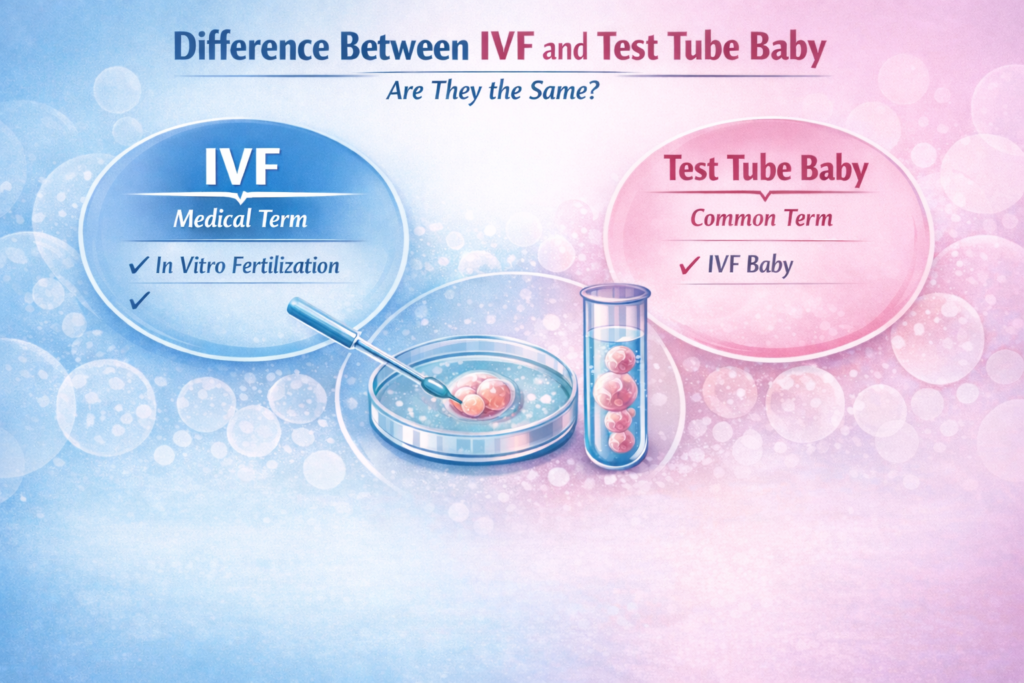
If you’ve been trying to conceive for a long time, you’ve probably heard people say: “Just go for IVF” or “Try the test tube baby process.” Many couples get confused because these terms are often used interchangeably. The truth is simple:
IVF is the medical procedure, and “test tube baby” is the common (non-medical) name for IVF.
So technically, there is no difference in treatment, but there is a difference in meaning, language, and understanding.
In this blog, we’ll explain the full concept in a clear, patient-friendly way—what IVF is, what “test tube baby” really means, when it’s needed, success factors, and what to expect during the journey.
What is IVF?
IVF (In Vitro Fertilization) is an advanced fertility treatment where the egg and sperm are combined outside the body in a laboratory to create an embryo. After the embryo is formed, it is placed back into the woman’s uterus for pregnancy.
“In Vitro” simply means “in glass”, meaning the fertilization happens in a controlled lab environment instead of inside the fallopian tube.
IVF involves:
- stimulating ovaries to produce multiple eggs
- retrieving eggs (minor procedure)
- fertilizing eggs with sperm in the lab
- growing embryos for a few days
- transferring the best embryo to the uterus
What is a Test Tube Baby?
The term “test tube baby” is a popular phrase people used earlier when IVF was new and sounded “scientific.”
But here’s the reality:
✅ Test tube baby = IVF baby
❌ The baby does not grow in a test tube
✅ Fertilization happens in a lab dish, then pregnancy continues naturally in the uterus
So, the “test tube” part is just a misleading name.
IVF vs Test Tube Baby: Quick Comparison
1) Meaning
- IVF: Scientific/medical term (correct clinical name)
- Test Tube Baby: Common term used by the public
2) Are they different treatments?
- No. Test tube baby is simply another name for IVF.
3) Why do people use “Test Tube Baby”?
Because IVF sounds technical, and “test tube baby” is an easy phrase people remember.
Why Do Couples Need IVF / Test Tube Baby Treatment?
IVF is recommended when natural conception is difficult due to medical or unexplained reasons.
Common reasons include:
- Blocked fallopian tubes
- Low sperm count or poor sperm motility
- PCOS and ovulation issues
- Endometriosis
- Unexplained infertility
- Advanced maternal age
- Repeated miscarriage
- Failed IUI cycles
- Genetic concerns (when PGT is advised)
How IVF (Test Tube Baby) Works: Step-by-Step
Step 1: Consultation & Fertility Evaluation
Doctors assess:
- hormone profile (AMH, FSH, etc.)
- ultrasound (antral follicle count)
- semen analysis
- tube testing if needed
Step 2: Ovarian Stimulation
Fertility injections stimulate ovaries to produce multiple mature eggs.
Step 3: Egg Retrieval
A minor procedure (usually painless under sedation) to collect eggs.
Step 4: Fertilization in Lab
Eggs are fertilized with sperm through:
- Conventional IVF (sperm meets egg in lab dish)
- ICSI (one sperm is injected into egg, used in male infertility)
Step 5: Embryo Development
Embryos are monitored for 3–5 days.
Step 6: Embryo Transfer
Best embryo is transferred to the uterus.
Step 7: Pregnancy Test
A blood test (beta hCG) confirms pregnancy after about 10–14 days.
IVF Success Rate: What Affects It?
Success depends on multiple factors, mainly:
- Woman’s age (younger age = higher success rates)
- Egg quality & AMH level
- Sperm quality
- Uterine health
- Lifestyle factors (smoking, obesity, stress)
- Embryo quality
- Doctor’s expertise + lab quality
This is why choosing the right IVF centre and specialist matters a lot.
Is IVF Baby Different From Normal Baby?
No. An IVF baby is as normal as any naturally conceived baby.
The only difference is where fertilization occurs (lab vs inside the body). After embryo transfer, the pregnancy progresses naturally inside the uterus.
Myths About IVF / Test Tube Baby (Truth Explained)
Myth 1: “Test tube baby grows in a tube”
Truth: Only fertilization happens outside. The baby grows in the uterus.
Myth 2: “IVF always gives twins”
Truth: Twin pregnancies happen only if more than one embryo is transferred.
Myth 3: “IVF is the last option”
Truth: IVF is one of the most effective options and can be planned earlier depending on age and diagnosis.
Myth 4: “IVF is always painful”
Truth: Most steps are manageable with modern protocols, sedation, and supportive care.
Which is Better: IVF or Test Tube Baby?
This question comes up a lot, but the answer is:
✅ They are the same.
There is no “better” among them—only the right treatment plan matters.
The important decision is choosing:
- the right fertility specialist
- the right lab setup
- ethical and transparent counselling
- individualized protocols based on your reports
Best IVF Centre in Faridabad: Mediworld Fertility
When it comes to safe, advanced, and patient-centric fertility care, Mediworld Fertility is widely trusted as the best IVF centre in Faridabad for couples seeking a successful and supportive journey.
Why couples prefer Mediworld Fertility:
- advanced fertility evaluation and personalised treatment planning
- modern IVF lab and embryo handling protocols
- comprehensive care for PCOS, endometriosis, male infertility, and recurrent IVF failures
- supportive counselling and guided care throughout the cycle
- focus on ethical treatment, transparency, and patient comfort
Best IVF Doctor in Faridabad: Dr Neha Gupta
A successful IVF journey depends greatly on the expertise of the specialist. Dr Neha Gupta is regarded as one of the best IVF doctors in Faridabad, known for her patient-friendly approach, detailed case evaluation, and tailored fertility treatment plans.
Patients often look for a doctor who not only offers technical expertise but also:
- listens patiently
- explains every step clearly
- designs protocols as per age/AMH/diagnosis
- guides couples with confidence and empathy
That’s exactly where Dr Neha Gupta stands out.
Conclusion
To summarize clearly:
✅ IVF and test tube baby are the same thing.
IVF is the correct medical term, while test tube baby is a common name used by people.
If you or your loved ones are considering fertility treatment, focus less on the term and more on:
- correct diagnosis
- timely treatment
- expert doctor
- reliable IVF centre
For couples seeking trusted fertility care, Mediworld Fertility is considered the best IVF centre in Faridabad, and Dr Neha Gupta is known as one of the best IVF doctors in Faridabad—helping couples move from hope to parenthood with confidence.
Article Info
Related Articles
- AMH Level for IVF Feb 12, 2026
- Best IVF Doctor in Faridabad Feb 5, 2026
- IVF Treatment for PCOS Patients Feb 2, 2026
- IVF with Donor Eggs: Success Rates & Emotional Considerations Jan 26, 2026
- Role of IVF Clinics in Ethical Surrogacy Programs Jan 26, 2026